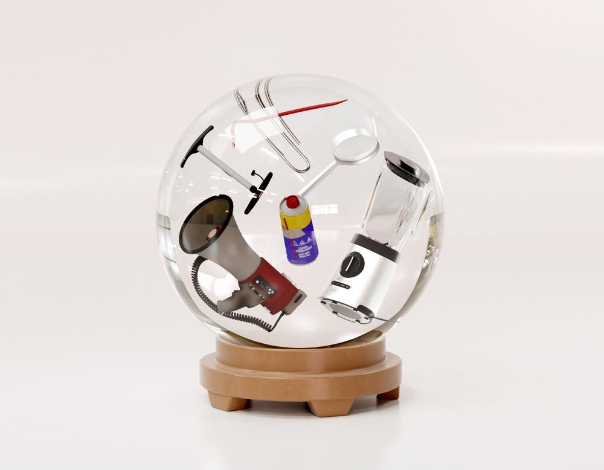
Infinite Vacuum Hose (Collage for Murf/Murw Magazine #16 2024 by Renée van Oploo)
This research focuses on the role of the artist in public spaces, with placemaking as a starting point. The concept of placemaking serves as a framework for exploring both the possibilities and limitations. Placemaking presents various dilemmas. On the one hand, it is seen as a tool to democratise public spaces, but this prompts the question: who decides how these spaces are shaped? Artistic practices are sometimes instrumentally employed to foster such communities, but the ethical implications must be critically examined. How can artists contribute to public spaces without merely serving commercial or gentrification interests? Part of the research on placemaking focuses on the Modellprojekt Haus der Statistik in Berlin (in collaboration with Professor Sebastian Olma), where radical proposals for urban development are being made, with a central role for civil society. The role of the artist in these processes is a key question.
Additionally, the research examines and specifically focus on the role of art in public spaces. Artworks in public spaces often engages with complex themes such as world peace, climate change, and inclusivity. My research investigates how the ideologies behind artworks are translated into tangible impact. I aim to find a constructive way to navigate the dilemmas surrounding public art, including the roles of commissioning, disengagement, and participation.
A strong connection with my own artistic practice is central to this research. It is essential to not only approach this research not only theoretically but also to integrate this visually and artistically. The results, dilemmas and questions of the research are tested in practice. One example is this is a residency at the EKWC (European Ceramic Work Centre) in Oisterwijk.
Gut Feeling
Duringthisthree-month artist residency at the European CeramicWork Centre (EKWC), I developed a series of ceramicsculptures in whichthe body, dailyhabitsandmaterial research werecentral. In Pan Colon(s) I seek, through sculptural experiments, a personal reflection on the colon, as a tangible and emotionally charged organ that embodies both bodily vulnerability and a broader, intuitive or societal imbalance. The residency led tothe essay Gut Feeling, a philosophical-artisticdialoguethatexploresdoubt, ethics, andaesthetics.
Toolbox for the Evaluation of Art in Public Spaces
One of the outcomes of the research is the development of a Toolbox for the Evaluation of Art in Public Spaces. This toolbox proposes a series of metaphorical instruments, from a crowbar to a head massage tool, that were tested across various case studies. The central question was whether such a toolbox could function as a usable and critical form of evaluation in a field that is often marked by ideological expectations and complexity. Rather than offering a fixed methodology, the toolbox operates as an invitation to moral reflection.
In press, October 2025, in RUUKKU (a multidisciplinary, peer-reviewed journal on artistic research)
Toolbox for the Evaluation of Art in Public Spaces (2024 by Renée van Oploo)
Workshop: Welcome to the Weird & the Dirty
As part of the Studium Generale programme, the workshop Welcome to the Weird & the Dirty was developed in collaboration with Rob Leijdekkers and Professor Sebastian Olma. It set out to critically redefine the concept of regeneration — not as a pure or solution-oriented process, but as something ambiguous, embodied, and messy. Through roleplay, participants explored imagined futures not based on consensus, but on radical nuance. Each participant introduced themselves through a “sin” and moved through the space from that perspective, taking on roles such as philosopher, gardener, pirate, surgeon, or mafia member. Behaviour, aesthetics, and ethics were mapped onto different ecological zones, allowing friction and discomfort to become part of the learning environment.
A variation of this workshop was later delivered as part of the Ecology & Futures master lecture series and during the Avans Day programme titled Creativity and Critical Imagination – Weird & Dirty. An adapted version was also presented alongside an exhibition by Hedwig Houben and Rob Leijdekkers at Atelier Néerlandais in Paris, engaging students from St. Joost and several Paris-based art schools. We are currently exploring how this workshop can be further developed for use beyond academia, such as in professional or organisational settings.
Educational Workshops
Welcome to the Weird & the Dirty
A performative workshop developed with Rob Leijdekkers and Sebastian Olma, and Jess Henderson. Participants explored regeneration as an ambiguous, bodily, and messy process through roleplay, navigating fictional identities and ecological zones. The workshop was held in multiple contexts, including Studium Generale, Avans Day, and an exhibition in Paris.
Decision-Making & Togetherness
A performance-based exploration of collaboration, focused on group dynamics, values such as care and conflict, and collective organisation in the context of graduation preparation.
Scale and Scope of Engagement
In collaboration with YAFF, Femke van Heijningen and Klaar van der Lippe, students translated the urgency of artistic work into everyday settings like supermarkets and local councils, making speculative proposals for future societal relevance of art.
Radical Nuance
This research continues by departing from dilemmas in my own and shared artistic practice to ask: what is the role of art in a society marked by conservatism, populism and moral regression? While progressive terms such as regeneration, resonance and care circulate within the arts discourse, they clash with a reality shaped by marketisation, instability and distrust. Within this tension, the research focuses on arts education as a space for rehearsal. Rather than striving for consensus, Renée explores friction, uncertainty and ambiguity as formative forces. Renée investigate how artistic practices can contribute to a curriculum that not only questions but also equips future artists with concrete tools for navigating ethical complexity and cultivating imaginative action.
Ongoing research (starting date September 2024)
‘Within my practice I create spaces for introspection while exploring ethical dilemmas. ’
In 2017, I graduated from St. Joost in Den Bosch, and I hold a Master’s in Applied Ethics from Utrecht University. Presently, I work as an artist, am an active member of the YAFF art collective, and concurrently serve as a lecturer.
The research group Cultural and Creative Industries investigates the role of artists and designers as creative innovators and drivers of social and economic change. Affiliated researchers analyse the cultural and creative industries from a critical point of view and examine the conditions under which timely forms of aesthetic expression and social connectedness can actually take place within the precarious reality of this field. What economic models are required by artists and designers to create a meaningful practice within the aesthetic, social, and economic intentions of the cultural and creative industries? What skills sets are required for those artists and designers who don’t just want to follow movements, but actually shape novel social and economic models of the future?