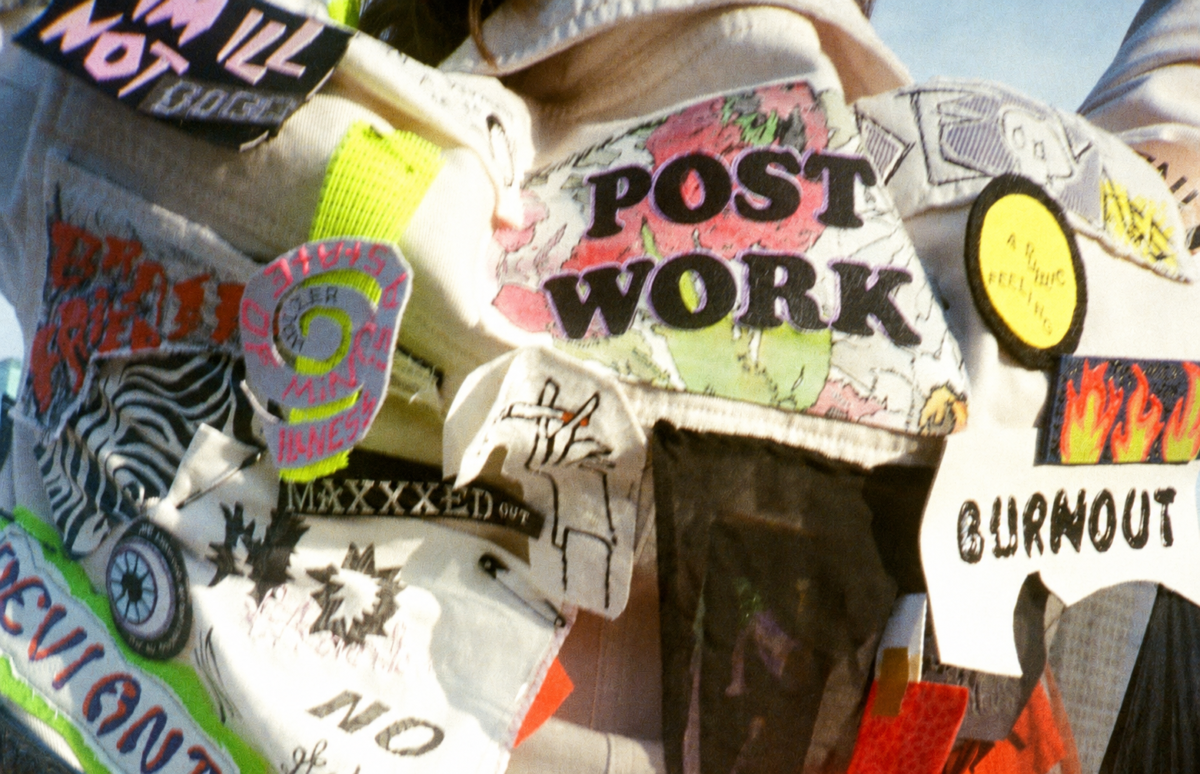
Post-Work: Towards another kind of creative industry is an artistic research project investigating the mental health challenges faced by today’s creative workers. It is part of the Professional Doctorate programme that utelises practice-based research for projects focused upon societal change. Within this space, Post-Work takes a transdisciplinary and participatory action research approach towards providing a deeper understanding into the trials and tribulations of making a living from creative work today.
This project, led by researcher Jess Henderson, situates its research field within the creative industry, though different to how much of the academic work that has come before it has done so. The ‘Cultural and Creative Industries’ (CCI) is considered an economic sector by the EU, but for us it is a social milieu, a site of work, as well as a place where everyday lives and interactions happen. Hence, we use the singular term (the creative industry) as this is how it is commonly and colloquially referred to between workers.
One of this project’s aims is to research the creative industry from a “boots on the ground” perspective where valuable and often overlooked knowledge is produced through lived experience. Jess herself has long worked within this space before turning towards researching it, allowing for the meeting participants where they are at and having similar first-hand experiences of the multitude of factors (including those societal, cultural, economic, and political) that influence or cause such challenges to arise. Collapsing the traditional paradigms of researcher vs. researched, emphasing participation rather than observation, and using practices where knowledge is produced collectively rather than extracted, are all informing aspects of the project’s methodologies.
Methodologies & Approaches
Here are a handful of the project’s research methodologies and approaches.
Deep Hanging Out
- Through research activities like after hours get-togethers for creative workers, like collective making workshops, sharing sessions, or others forms of informal gathers, Post-Work takes inspiration from the notion of ‘Deep Hanging Out’ that has its roots in ethnography. Rather than treating research participants as subjects to be studied from a distance, Deep Hanging Out emphasises spending extended, informal, and immersive time together where the researcher participates with participants – learning through shared experiences and presence to generate detailed contextual accounts of social life.
- Building upon this, this research project extends the above further (in ways that could possibly be seen as giving it an ‘update’ upon its 90’s origins) by drawing upon notions, traditions, and practices that do have overlaps, particularly in being together as a mode of knowing. One is Harney and Moten’s Black study that also rejects the idea that knowledge is produced only through formal, structured, institutional procedures and reframes ‘study’ as an ongoing social practice that often occurs in places and moments traditional academia would deem as illegitimate, insignificant, or as nothing other than ‘just hanging out.’ Black study adds that people are already studying together, differing from classical anthropology where the researcher may be hanging out with participants or a community to understand them but qualities of extraction or ‘observation from the outside’ still run risk of presence.
Zine-Making
- Zine-making is used in Post-Work as both a practice of doing research and a way of sharing and disseminating it. Rather than treating knowledge or findings as something published solely through academic articles, for example, zines allow ideas, experiences, and alternatives to be circulated in ways that are more accessible than a published article (for example) and more likely to reach those who can benefit from them most. Practices like zine-making help bring to life things that can be difficult to articulate in formal settings or have previously not had the space to be made visible or heard. In this project, zines help to open up who gets to produce knowledge, what knowledge is legitimate, how it is shared, and who it is for/who it can reach.
- Born out of important histories like DIY culture and underground political movements, the beauty that remains within zines are their abilities in being able to circulate outside of institutional channels, that they are low-cost and easy to reproduce, as well as the vastness of freedom of expression they allow. The project drawns upon zines as ‘technologies’ for experimental and urgent publishing, vernacular and tacit knowledge, and as a way of meaning-making and collectivity/community organisation.
Care, Context, and Conditions
- Rather than treating mental health challenges as individual problems to be managed or overcome, Post-Work understands them as shaped by the conditions of contemporary creative work. Experiences such as burnout, precarity, questions regarding the encroachment of AI upon professions, and overwhelm or exhaustion are not seen as personal failings, but as resultant of wider systems that structures that background creative labour today. In fields, disciplines, and an industry that often pressurises productivity, self-branding/self-promotion, and flexibility, the inherent notions that suggest these challenges ought to be internalised can be intense. This reflects how wider systems can make structural problems feel like personal ones (a dynamic explored by theorists such as Mark Fisher.) This project instead asks what causes such experiences, how they are produced, and what becomes visible when they are understood collectively from this perspective over seen as individual shortcomings.
- This framing is informed in part by feminist practices of consciousness-raising that emerged in the 1960s and 70s, where small groups gathered to share personal experiences and, through this process, were able to recognise them as political and structural rather than private issues. These practices showed how ‘the personal’ is deeply connected to broader social conditions, and how speaking openly with others can shift understanding from self-blame to collective awareness. Within Post-Work, the aim is to create spaces where people can reflect together on their experiences and find solidarity – not in search of solutions or fixes, but to better understand how these challenges take shape, and how they are lived within the creative industry today.
Ongoing project (started January 2026)