Exploring the role of communication in social reintegration
Mind the Gap is a practice-based research project led by Avans Centre of Expertise Safe & Resilient Society in collaboration with CARADT researcher Jenny van den Broeke. The project explores how communication influences collaboration and reintegration in the social domain. Central to the project is a serious game, developed as an evaluation tool for professionals such as case managers and municipal coordinators.
Serious Game ‘Mind the Gap’
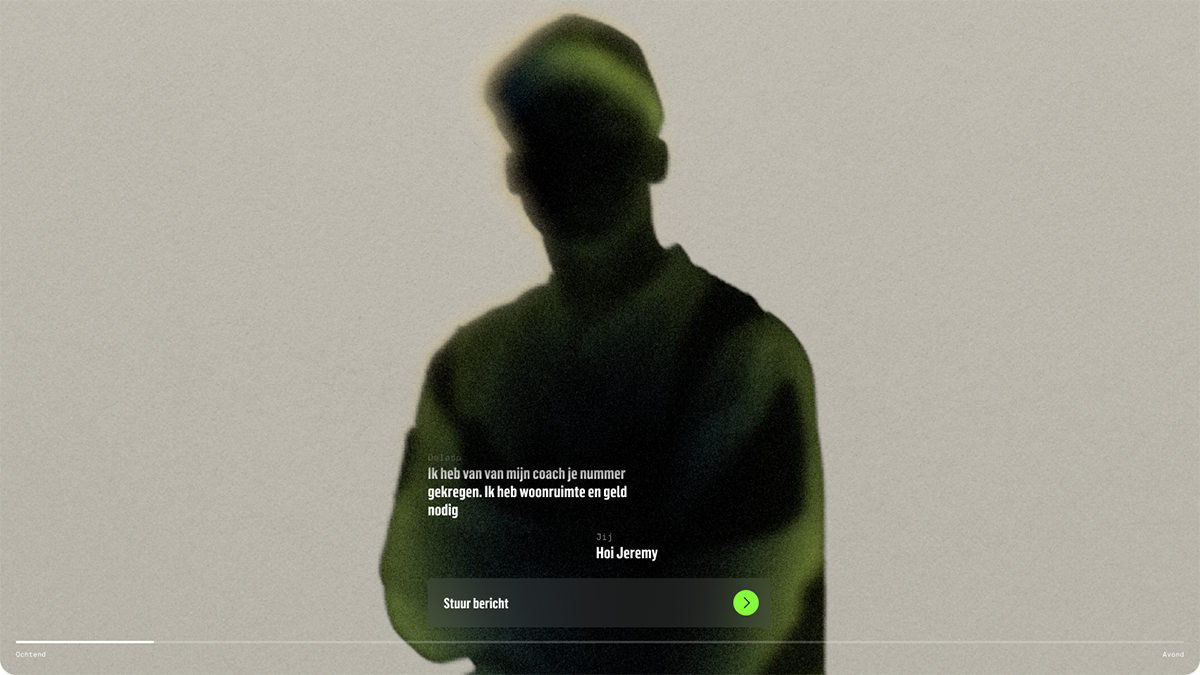
In the game, players take on the role of a case manager supporting Jeremy, a 24-year-old recently discharged from a closed mental healthcare institution, with no access to housing or income. Over the course of 30 minutes, players are challenged to make decisions under time pressure, set priorities, and interact via a chat interface with AI-driven characters such as Jeremy, his coach, and municipal officers. Each interaction is dynamically generated and uniquely responsive by use of ChatGPT.
The aim is to provide a safe and playful environment in which professionals can reflect on their communication styles and learn how these impact decision-making and collaboration in complex professional settings.
AI-driven dialogue and behavioural feedback
Each AI character in the game exhibits a distinct communication style and emotional state. The player’s challenge is to align with these varying needs in order to foster constructive cooperation. Upon completing the game, players receive individual feedback not only on what they achieved but also on how they communicated — and the effect of their choices.
Relevance and professional context
Mind the Gap was designed to closely reflect the realities of professional life in the social domain. Research within the project has shown that breakdowns in communication (or “friction”) can delay or hinder service provision. The game provides a low-threshold, accessible way for professionals to practise both what they do and how they address and engage others in the process.
The characters’ behaviour is not based on static scripts but reacts dynamically to user input, making each session slightly different. This contributes to the authenticity and learning value of the experience.
Development, testing, and follow-up
The game has been tested during multiple workshops, including sessions with the municipalities of Zoetermeer, Amsterdam, and Breda. It was also presented at the Dutch Design Week as part of Avans District 2035, and more recently during the symposium Kom over de Brug! (November 2025), where participants explored the tool in relation to interprofessional collaboration.
Further development of the game is underway. A next version will incorporate insights from these test sessions, and a platform is being explored. This would enable organisations and educational institutions to develop theirown custom scenarios and characters tailored to specific learning goals.