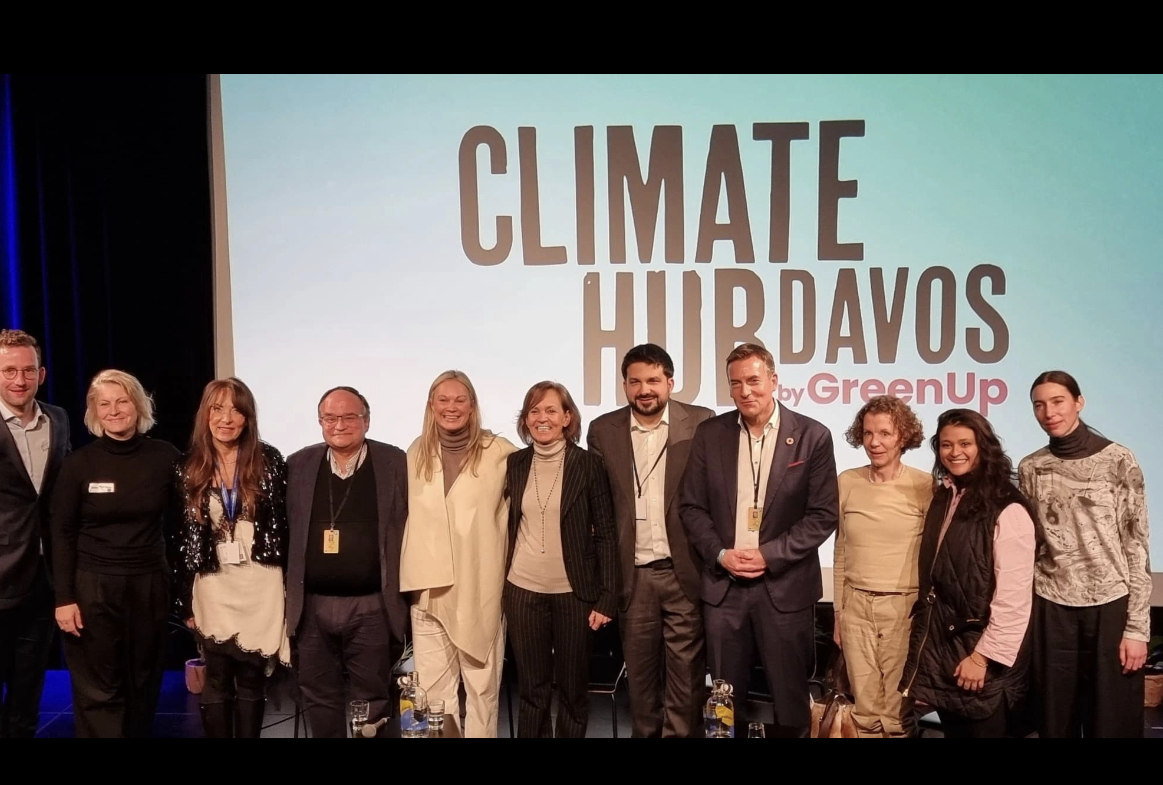
The event brought together innovators, policymakers, scientists and practitioners to explore regenerative, resilient and nature-positive solutions. Convened in the context of the emerging Global Regenerative Innovation Alliance (GRIA), the session examined how regenerative transitions can be financed, built and scaled in real-world contexts.
Delfina described these panel sessions as important steps in forging regenerative alliances committed to advancing the shift from extractive systems to regenerative ones.
Panel 1 | Unleashing Capital – How to Finance Regenerative Infrastructure
Delfina participated in the first panel, moderated by Christian Schmitz (Founder & CEO, PDIE Group). The discussion addressed the question: How do we make nature-positive infrastructure investable and bankable?
The panel brought together Dr. Barbara Weber (B Capital Partners), Maxime Nassour (Saphi), and Delfina Fantini van Ditmar. Based on her regenerative design expertise, Delfina addressed the systemic needs of regenerative approaches in relation to existing legacy systems, as referenced in the session description.
The conversation explored how regenerative infrastructure can be financed and what conditions are required to enable regenerative transitions in practice.
Panel 2 | Building Back Better – The Regenerative Built Environment
The second panel, moderated by Dr. Barbara Dubach (Innovate 4 Nature), focused on the built environment and examined how cities, materials and urban systems can become drivers of regeneration. Contributions were made by Susanne Gløersen (The Future is Fungi Award), Carlos Alvarez Pereira (Club of Rome), Karina Peña (FieldFactors), and Andre Vreman (Climate Neutral Real Estate).
Across both panels, the session aimed to spark partnerships and accelerate scalable impact through tangible projects and real-world initiatives.
About Climate Hub Davos
Climate Hub Davos takes place annually during the week of the World Economic Forum (WEF) in Davos, Switzerland. While the WEF convenes political, economic and institutional leaders to address global challenges, Climate Hub Davos provides a complementary platform focused specifically on climate action, regenerative transitions and nature-positive solutions. Hosted by GreenUp Switzerland and supported by various partner organisations, the Hub creates space for dialogue between practitioners, researchers, policymakers and innovators working on concrete pathways towards systemic transformation.
‘How can art and design cultivate critical expressions rooted in ethics of care and relationality to influence ecological, social, and economic structures?’
Delfina Fantini van Ditmar, PhD, focuses on ecological design and reflective practices as Professor Regenerative Art and Design. With a background in biology and design research, she explores paradigm shifts and material ethics, advancing regenerative and more-than-human perspectives