Eva Fotiadi Leads Workshop on Multisensory Curating in Germany
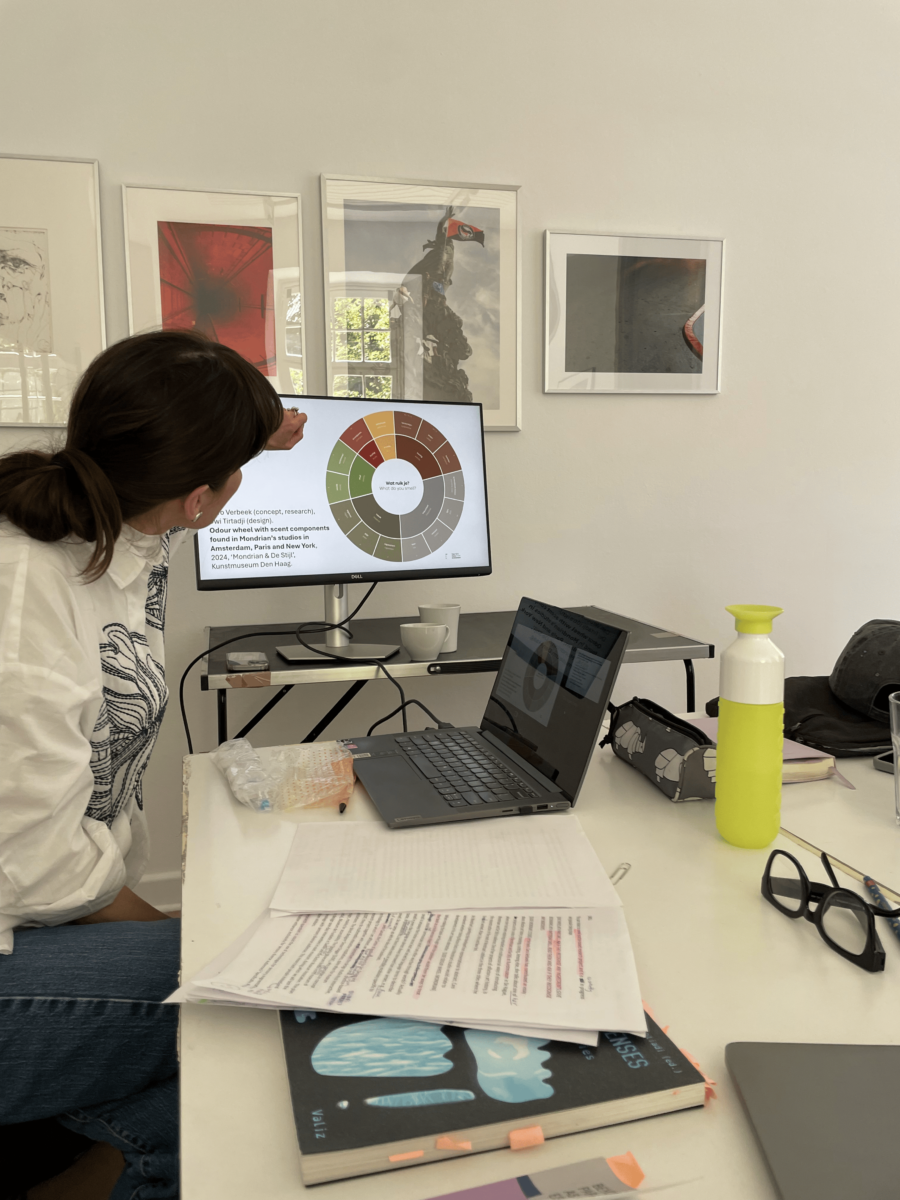
On April 29, Eva Fotiadi led a workshop in Bielefeld, Germany, for curators and staff from Kunstverein Bielefeld, Neue Galerie Cologne and Kunstverein Siegen. The workshop was based on her ongoing research into non-visual sensory perception and the role of disabled knowledge and skills within curatorial and artistic research.
The event was organised as part of a collaborative programme between the three institutions and supported by Übermorgen – New Models for Cultural Institutions, a funding programme of the German Federal Cultural Foundation (Stiftung des Bundes). The aim of Übermorgen is to sustainably strengthen fundamental structural change in cultural institutions and innovative future projects, and to enhance the perception of cultural institutions as a social good, as well as their impact on society.
During the workshop, Eva shared insights from her research that culminated in the publication Exhibiting for Multiple Senses, while also highlighting projects and experiences contributed by the book’s collaborators. In addition, she presented recent developments from her research, including the 2025–2026 projectInclusive Technologies for Museums: Sensory Substitution and Augmentation for Inclusive Exhibitions. This project is carried out by the Situated Art, Design and Technology (SADT) research group at CARADT and is supported through a KIEM MV grant.
The workshop was documented live by disabled illustrator, comic artist and designer Hatiye Garip , founder and creative producer of the Accessible Lines project, whose visual documentation captured the discussions and exchanges throughout the day.
‘Could experimental sensory translation of art works improve their accessibility for sensory diverse exhibition audiences?’
Eva Fotiadi is a researcher within the Situated Art, Design and Technology research group and a theory tutor at the St Joost School of Art and Design, where she is also a member of the Diversity Dialogues platform
Research Group: Situated Art, Design and Technology
The research group Situated Art, Design and Technology (SADT) focuses on the societal embedding and embodiment of knowledge production that art and design research enables. The conducted research contributes to a deeper understanding of technological developments and their impact on people, society, and the environment, and to the development of situated approaches in the creative sector and beyond. In doing so, it advances a wider acknowledgement of artistic and design research as a mode of knowledge production, one that is grounded in creativity and critical imagination as a way of generating insight into, and intervening in, societal transitions driven by technology.