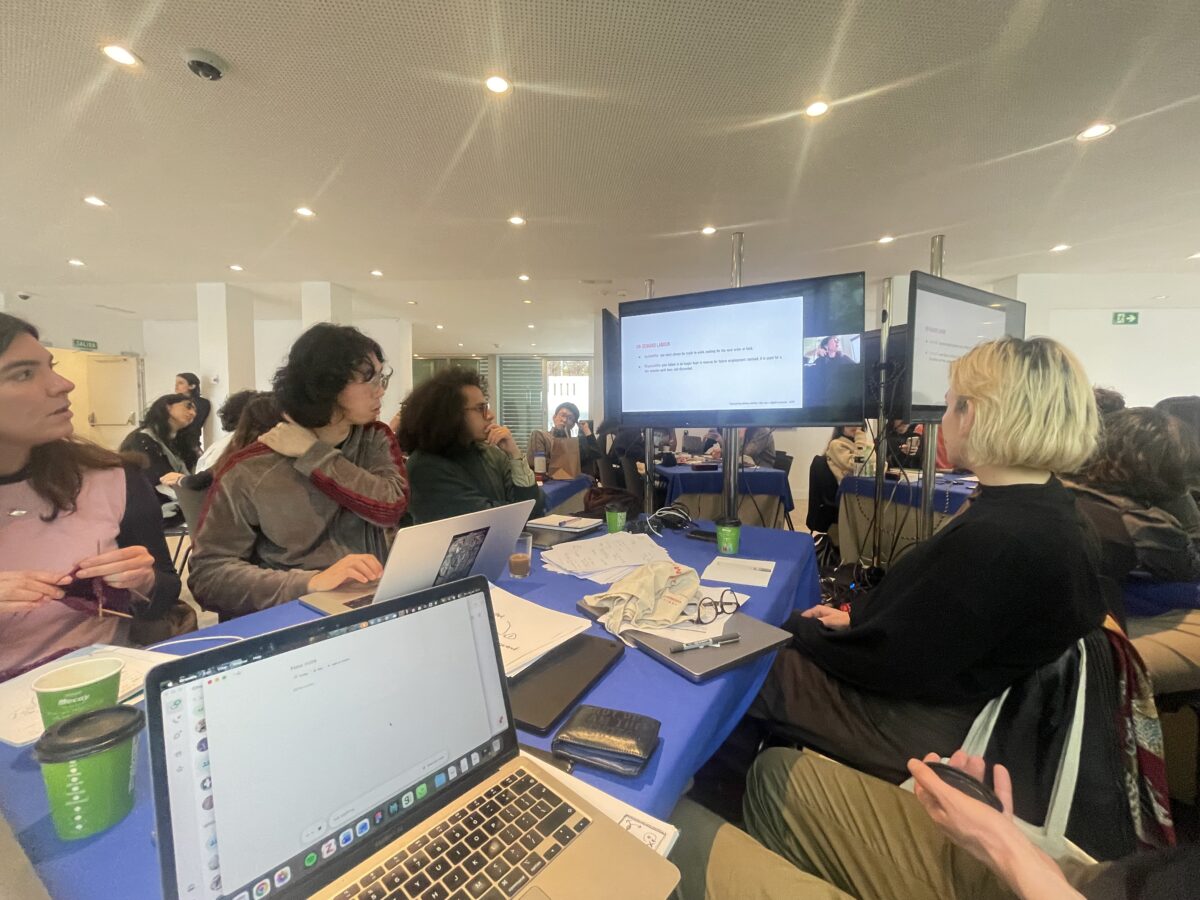
Hugo Garcia from CARADT is participating in Organismo | Art in Applied Critical Ecologies, an international residency exploring how art and design can actively shape responses to the climate crisis. The program brings together artists, designers, scientists, and policymakers to develop experimental, practice-based approaches to urgent ecological challenges.
Initiated by TBA21 Academy and Museo Nacional Thyssen-Bornemisza, Organismo operates through a series of applied case studies rooted in specific territories. These local investigations address global issues such as climate change, extractivism, and ecological degradation, positioning artistic practice as a catalyst for systemic transformation.
Last Resorts: preparing for climate uncertainty
Within the residency, CARADT’s Regenerative Art & Design (RAD) researcher is contributing to the case study Last Resorts, led by Gary Zhexi Zhang. The project is situated in Marjal dels Moros, a wetland area in the Valencia region that is increasingly affected by extreme rainfall and flooding.
Working in collaboration with partners including the Basque Centre for Climate Change and European policy institutions, the team investigates how societies anticipate and prepare for climate-related disasters. A key focus lies on the role of insurance systems and risk modelling, and how these frameworks might be reimagined to stimulate investment in environmental restoration and long-term resilience.
Rather than approaching floods as isolated events, Last Resorts examines how economic, ecological, and social systems intersect, and how they shape the conditions for living with ongoing environmental instability.
From climate data to shared imaginaries
As the impacts of climate change intensify, future scenarios increasingly influence decisions in the present. These imaginaries, whether technological, economic, or catastrophic guide policy, shape investments, and affect how communities prepare for what lies ahead. Yet they often remain abstract, disconnected from lived experience, or limited to dominant institutional perspectives.
The Last Resorts working group explores how alternative imaginaries of climate futures can emerge through artistic and design practices. By connecting data, mapping, and local narratives, the team investigates how new forms of understanding and engagement can be created, ones that make climate risk tangible, shared, and actionable.
CARADT: critical imagination as a driver for change
This research trajectory closely aligns with CARADT’s approach to practice-based artistic and design research, where creativity and critical imagination are understood as essential forces in addressing complex societal transitions.
By embedding research within real-world contexts and engaging with ecological, technological, and social systems, CARADT positions art and design as active agents in shaping futures. Projects such as Last Resorts, in alignment with the Regenerative Art & Design research group, focus on regenerative futures and the re-visioning of systems, reflects this commitment: not only analysing existing structures, but also proposing alternative models and interventions that contribute to more ecological and equitable ways of living.
Collaborative research in context
The residency began with an intensive working week in Madrid, where participants from diverse disciplines came together to establish a shared framework. Through workshops on speculative futures, including the session Permanent Collapse facilitated by La cuarta Piel, the group developed a common language for collaboration.
Engagements with climate scientists from BC3 further grounded the work in the specific conditions of the Valencia region, highlighting both the urgency of intervention and the complexity of aligning different stakeholders. Within this context, art and design play a key role in articulating shared perspectives and opening up new possibilities for collective action.
Towards a prototype and future implementation
The residency will conclude in June with the presentation of a prototype at the Museo Nacional Thyssen-Bornemisza in Madrid. Following this, selected projects will enter a new phase of development and real-world testing.
For Last Resorts, the ambition is to contribute to a cultural and systemic shift: from reacting to climate disasters towards collectively preparing for them, through new narratives, tools, and forms of engagement.
‘How can we find new materials and products that rely on interdependence between communities and ecological systems rather than extraction?’
Hugo F. Garcia is a design engineer and researcher working at the intersection of design, ecology, and material science. His practice combines traditional knowledge with scientific research and low-impact technologies to develop regenerative design systems.
The Regenerative Art and Design (RAD) research group seeks to contribute to a new generation of regenerative designers and artists who address the pressing need for transitions that support planetary health. By taking whole systems responsibility through collaborative practices, the group aims to create transformative pathways for reimagining design futures grounded in care and ecological integrity.